
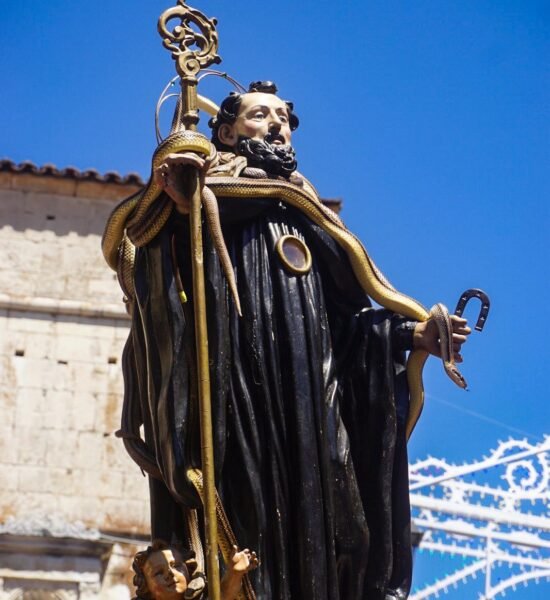
May 1st in Abruzzo is unlike anywhere else in Italy. From snake-draped saints to flower-crowned crosses, cheese-rolling contests to communal soup marathons — this is what the region’s most beloved public holiday really looks like. Check out our suggestions on what to do in Abruzzo on May 1st.
May 1st (il Primo Maggio) is a national public holiday in Italy — the Festa dei Lavoratori, or International Workers’ Day. Rooted in the late 19th-century labour movement, it commemorates the struggle for workers’ rights, including the campaign for the eight-hour working day. Banks, post offices, government offices, and most shops are closed. Many restaurants and bars do open, but it’s always worth checking ahead.
The Serpari Festival
Where: Cocullo (AQ)
No article about May 1st in Abruzzo can begin anywhere other than Cocullo, a tiny hilltop village in the province of L’Aquila that becomes, for one extraordinary day, one of the most photographed places in Italy.
Every May 1st, the statue of San Domenico Abate — the town’s patron saint — is carried through the narrow stone streets draped in live snakes. The serpari, local snake-catchers who spend weeks collecting the reptiles beforehand, drape their catch over the statue for the procession. It is a ritual of breathtaking strangeness, and it has been drawing pilgrims, photographers and curious visitors from across Europe for centuries.
The roots of the festival reach deep beneath the Christian surface: before San Domenico arrived in Cocullo in the 11th century, these hills were home to the Marsi, an ancient Italic people famed for their mastery of serpents and medicinal herbs. They venerated the goddess Angizia, associated with snakes, healing and the renewal of spring. The Church absorbed rather than erased this older world — and the result is one of Italy’s most striking examples of pagan-Christian syncretism. For more read our post about the Snake Festival in Cocculo and see the practical tips at the end of this article.
La Festa del Majo
Where: San Giovanni Lipioni (CH)
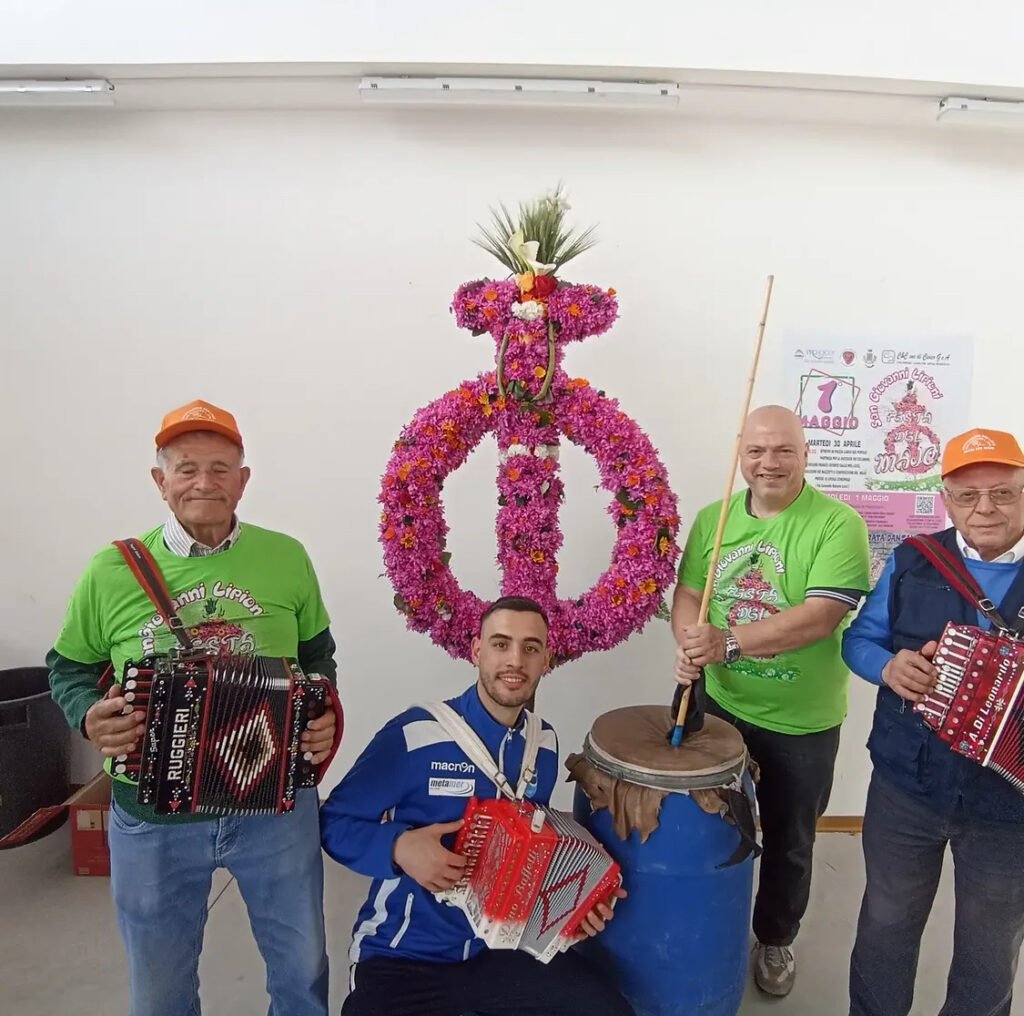
Of all the May 1st traditions in Abruzzo, the Festa del Majo in the tiny village of San Giovanni Lipioni (CH) is perhaps the most complete and most moving. It has everything: pre-Christian roots, religious procession, improvised poetry, communal feasting, and a village that — despite losing most of its population to emigration — pulls itself together every year for a celebration of extraordinary warmth.
Lu Maje is a tall wooden pole topped with a cross inscribed within a circle, covered entirely in small bunches of wild cyclamens and violets gathered from the surrounding woods, with ears of wheat and bean pods hanging from the summit — a fertility symbol as old as the hills around it. The rural chapel associated with the rite almost certainly overlays a pre-Roman sanctuary, possibly dedicated to Hercules Quirinus; with the spread of Christianity, the celebration was recast around the village’s patron saints, Santa Liberata and San Giovanni Evangelista, whose statues are carried in the procession.
The festa begins on April 30th, when volunteers of all ages head into the forest at dawn to collect the cyclamens. Back at the Pro Loco, after a shared lunch, everyone ties the flowers into the mazzetti that will cover the cross. It is the community making the tradition with its own hands.
On May 1st, mass is celebrated at a small rural chapel near the cemetery, then the procession descends into the village, lu maje at its head. From around 2.30pm the real heart of the day begins: the corteo degli auguri, the procession of good wishes, moving house to house through every street. At each door, the stornellanti of the Pro Loco sing an improvised rhyming verse naming the family inside, with a personalised wish or gentle joke. The flower bunches are gradually gifted to each household; the families respond with sweets, ventricina, capocollo, cheese and homemade wine. The eating and drinking accumulates joyfully through the afternoon, ending in the main square with folk songs, dancing, and a communal plate of spaghetti aglio, olio e peperoncino.
Why This Tradition Matters
San Giovanni Lipioni has only around 138 registered residents — and the real daily population is considerably lower. Like hundreds of Abruzzo’s inland villages, it has been hollowed out by decades of emigration. Yet every May 1st, sangiovannesi who have moved to cities across Italy and beyond return specifically for this celebration, throwing themselves into the preparation of the welcome feasts with the same energy as those who never left. Visitors arrive from neighbouring villages too, drawn by the food, the singing and the atmosphere of something genuinely alive. More information via ProLoco and Visit San Giovanni Lipioni pages.
Le Virtù Teramane
Where: Bisenti and other towns in the province of Teramo
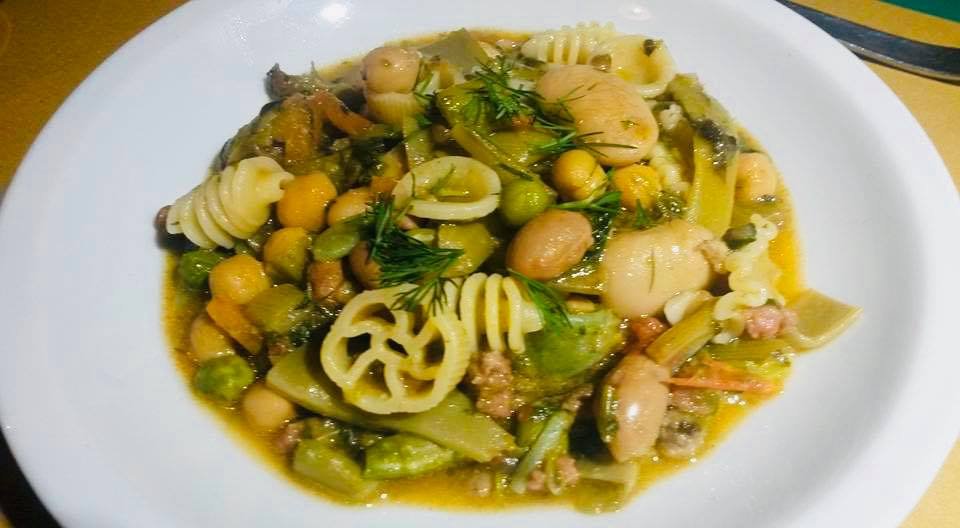
Ask anyone in Teramo about what to do on May 1 in Abruzzo and they will reply “If the Serpari festival is Abruzzo’s most spectacular May 1st tradition, “Eat Le Virtù!” It is a thick soup that takes days to prepare, requires dozens of ingredients, and is eaten almost exclusively on May 1st. It is the gastronomic rite of passage from winter to spring, a dish whose very complexity mirrors the agricultural transition it celebrates.
What Are Le Virtù?
The official disciplinare (regulatory code) of Teramo requires seven types of dried legumes, seven types of vegetables, and seven types of pasta — along with various cured meats, fresh herbs, and pork cuts — all combined in a single pot that simmers for hours. The exact recipe varies from family to family, and that variation is the point: every household has its own version, passed down through generations.
The origin is pragmatic and beautiful. The dish traditionally used up everything remaining in the winter larder — the last of the dried beans, the end of the stored lentils, the heel of the prosciutto — combined with the first fresh vegetables of spring: new peas, young chard, wild herbs. It is, literally, a dish that bridges two seasons. The name virtù is said to derive from the “virtue” required to prepare it patiently, or alternatively from the many virtues (ingredients) it contains.
The best place to eat Le Virtù is in and around Teramo and its province, where the tradition is most deeply rooted. On and around May 1st, dozens of restaurants in the Teramo area serve it as a set dish — some prepare it communally, with the cooking itself becoming a public event. The town of Bisenti hosts Bisenti Virttuosa, a dedicated festival celebrating the dish with tastings, cooking demonstrations and a convivial atmosphere in the historic centre.
Cheese rolling competition
Where: Villa Badessa (PE)
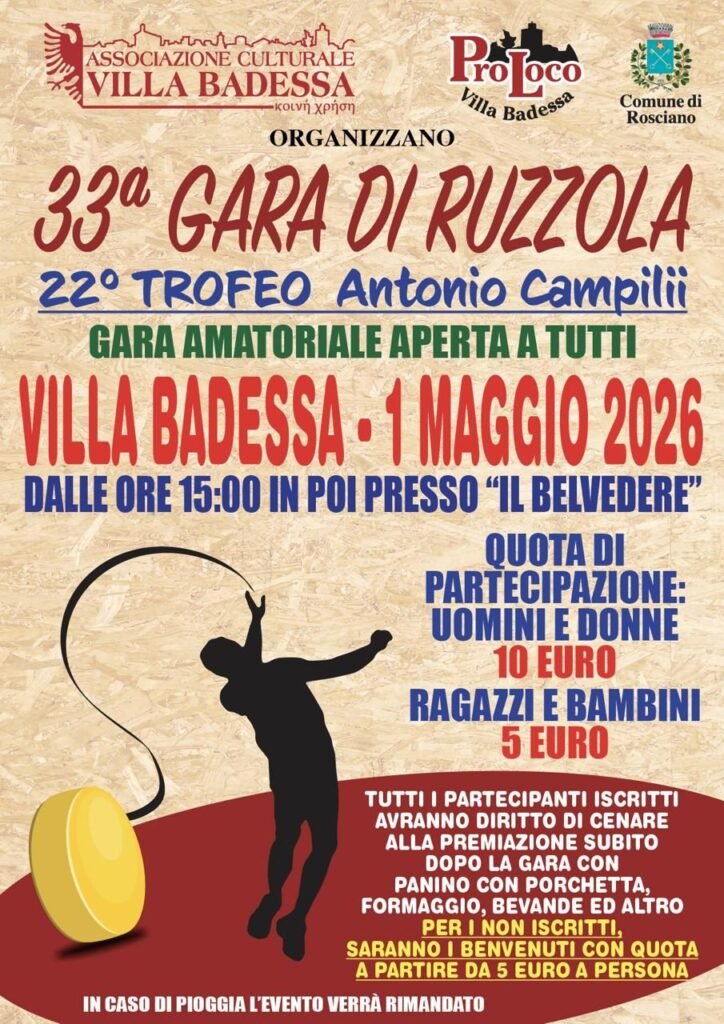
Few May 1st traditions in Abruzzo are as unexpectedly joyful as the Gara della Ruzzola held in Villa Badessa, a hamlet of about 400 inhabitants forming part of the municipality of Rosciano, in the province of Pescara.
The premise is simple: wheels of hard aged pecorino cheese are rolled along the town streets, guided by a cord wound around the form and tied to the player’s wrist. Whoever covers the greatest distance in three throws wins — and the traditional prize, dating to a rule codified in the 1500s, is the losers’ cheeses.
The ruzzola is one of Italy’s oldest folk games. The earliest known depiction appears in an Etruscan fresco in the Tomba dell’Olimpiade in Tarquinia, where a figure is shown in the throwing posture of a cheese-roller. The game spread across central Italy — Umbria, Marche, Lazio, Abruzzo — and survives today in several regional variants.
At Villa Badessa, the game was traditionally held on September 8th, the feast of the local patron saint. In 1991, the town’s cultural association revived it and moved it to May 1st — and it has been held every year since. The competition is open to all: serious players and enthusiastic beginners compete together, children and adults, and the atmosphere is decidedly festive. After the competition, everyone heads for a porchetta feast.
The location makes the tradition even more interesting. Villa Badessa is the only arbëreshë community in Abruzzo — a town founded by Albanian refugees fleeing the Ottoman conquest in the 15th century. The community maintained its Greek-Byzantine religious rite, its language (a form of medieval Albanian), and its distinct customs for centuries. The small church of Santa Maria Assunta, completed in 1754, still celebrates the Byzantine liturgy. Rolling aged pecorino wheels along the streets while cheering in dialect: it is hard to think of a more quintessentially Abruzzo afternoon. Start at 3pm. More details on the organisers’ page.
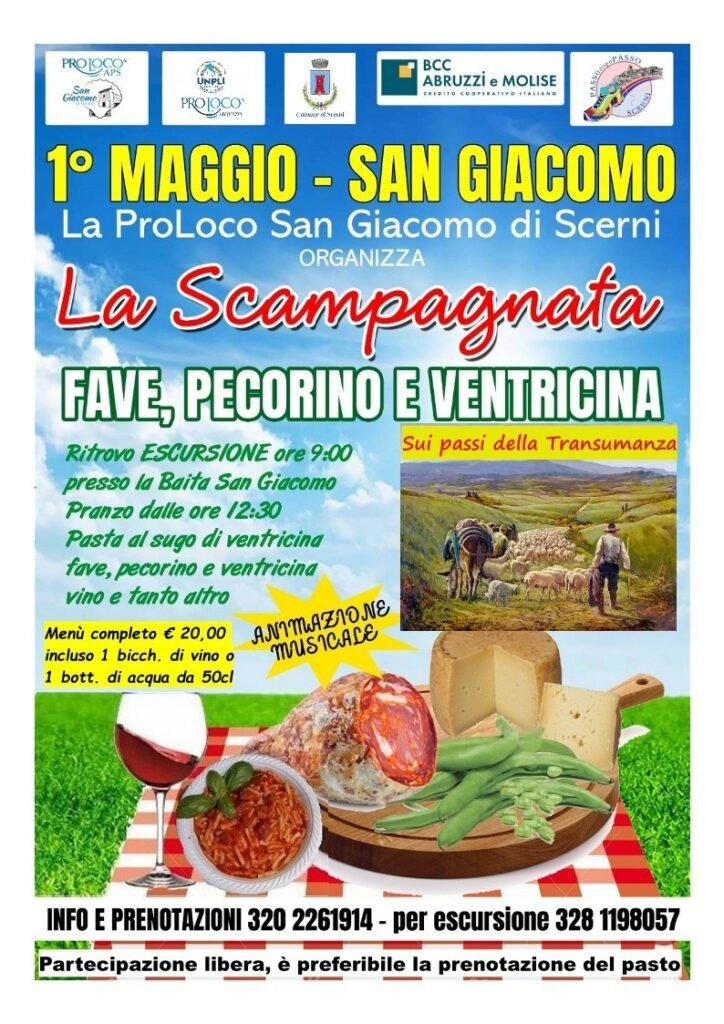
La Scampagnata
Where: Scerni (CH) and other locations
Not every May 1st tradition requires a procession or a recipe. The most universal one in Abruzzo — and across Italy — is simply going outside.
The scampagnata (countryside outing) is the unofficial national custom of May 1st: families, friends and neighbours pack food, load the car, and head for the mountains, hills, coast, or the nearest stretch of green. In Abruzzo, which offers everything from Adriatic beaches to Gran Sasso snowfields within an hour’s drive of most towns, the options are exceptional. One of the most organised — and most charming — versions of the scampagnata tradition happens in San Giacomo (area giochi e pic-nic “Fonte Sant’Angelo”), a hamlet of the municipality of Scerni in the Chieti province, where the event has become a proper community festival. The day begins at 9am with an optional free guided walk departing from the Baita meeting point: a roughly 6-kilometre, two-hour route through woodland, typical Scernese countryside and the area of the old agricultural school, classified as moderate but accessible. Bring trekking shoes, and expect a rest stop with refreshments offered by the Pro Loco halfway along. Those who prefer a gentler start can skip the walk and arrive directly for lunch, served from 12.30, followed by an afternoon of music, karaoke and group dancing that transforms the meadow into something between a town fete and a family reunion. Everyone can buy a picnic pack with pasta alla ventricina, fava beans, pecorino cheese and ventricina, wine and water at €20 (booking recommended; see the phone number on the flyer). Full details are on the ProLoco page.
On May 1st, even the beaches start to come alive. But the true Abruzzo beach experience on this day isn’t about swimming: walk along any stretch of the Adriatic coast and you’ll find families who have claimed their spot since morning, folding tables set up on the sand, and the unmistakable smell of arrosticini sizzling on the fornacella.
My Practical Tips for May 1st in Abruzzo — Lessons from Years on the Ground
I’ve been covering Abruzzo’s festivals and traditions for years at ABRUZZISSIMO Magazine, and May 1st is the one day where I often hear “why didn’t anyone warn me?” So consider this your warning.
Leave earlier than you think you need to. May 1st is one of the busiest driving days of the Italian year, and Abruzzo bears the brunt of it — the region pulls visitors from Rome, Naples and the whole of central Italy simultaneously. The A24, the A25, the coastal SS16 and the mountain roads can slow to a crawl by mid-morning. If you’re driving to any of the events above, I’d say 8am is the latest you want to leave.
Do not drive to Cocullo. The town closes its centre to traffic during the Serpari festival, and the access roads get gridlocked well before the procession begins with the motorway exit queues stretching for kilometres. Organised parking areas are set up outside the town with shuttle services into the centre — use them. Even better, take the train on the Sulmona–Avezzano line, which stops at the Cocullo station, a short walk to the town centre (about 10 minutes). It is the most stress-free way to get there, and arriving by rail with the other spectators has its own atmosphere.
Trenitalia adds significantly to its timetable for the occasion, running 14 trains stopping at Cocullo on May 1st — 9 of them special services — with around 4,000 seats available throughout the day. The station is just 800 metres from the festival area. Buy tickets in advance through the Trenitalia website or app; on the day itself, the station access is managed to control crowd flow, so arriving with a ticket already in hand saves time. Skip the festival altogether if you do not like big crowds.
Book your Le Virtù lunch weeks in advance. Restaurants in the Teramo area that serve the traditional soup on May 1st fill up fast. If you’re reading this in late April, call today.
Buon Primo Maggio a tutti!